©May 9, 2008, Christopher Carroll qModel
The Abel (1981)-Hayashi (1982) Marginal q Model
This handout presents a discrete-time version of the
Abel (1981)-Hayashi (1982) marginal ϙ model of investment.
1 Definitions
To simplify the algebra and intuition, we assume that a unit of
investment purchased in period t does not become productive
until time t + 1, so that the price paid in period t reflects
the present discounted value of the period-t + 1 price of
capital.
Adjustment costs are priced the same
way. ,
2 The Problem
The ϙ model assumes that firms want to maximize the net profits
payable to shareholders, definable as the present discounted value of
after-tax revenues after subtracting off costs of investment.
Formally, the firm’s goal is
Next period’s capital is what remains of this
period’s capital after depreciation, plus current
investment,
If capital markets are efficient, et will also be the stock market
value of the profit-maximizing firm because it is precisely the
amount a rational investor will be willing to pay if that investor
cares only about discounted after-tax income derived from owning
the firm.
The Bellman equation for the firm’s value can be derived (for
 = t + 1) from
which is equivalent to and defining jti = ji(it,kt) as the derivative
of adjustment costs with respect to the level of
investment,
the first order condition for optimization is
So the PDV of the marginal cost (after tax, including adjustment
costs) of an additional unit of investment should match the
discounted expected marginal value of the resulting extra
capital.
Recalling that πt = ηf(kt), the Envelope theorem for this
problem can be used on either (4) or (5):
and equivalently for period t + 1 so that (6) can be rewritten as the
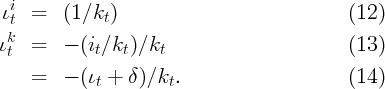
Euler equation for investment, It will be useful to define the net investment ratio as the Greek
letter ι (the absence of a dot distinguishes ι from the level of
investment i), which reflects the proportion by which investment differs from the
amount necessary to maintain the capital stock unchanged. It has
derivatives
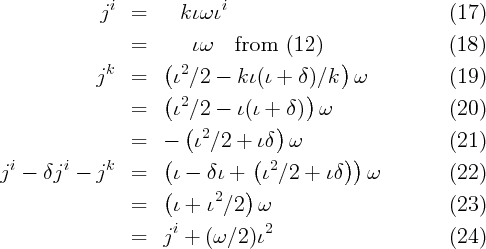
We now specify a convex (quadratic) adjustment cost function as
with derivatives so the Euler equation for investment (10) can be written
To begin interpreting this equation, consider first the case where
the costs of adjustment are zero, ω = 0. In this case ji = jk = 0 and
the Euler equation reduces to
Simplifying further, suppose that capital prices are constant at
p = 1 and the ITC is unchanging so that the after-tax price of
capital is constant at  . Then since 1 + r + δ ≈ 1∕βℸ, the equation
becomes
. Then since 1 + r + δ ≈ 1∕βℸ, the equation
becomes
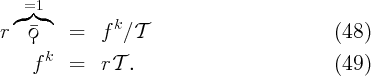
This says that the cost of buying one unit of capital,  , is equal
to the opportunity cost in lost interest plus the depreciation, (r + δ),
which must match the (after-tax) payoff from ownership of that
capital. Notice that this corresponds exactly to the formula for the
equilibrium cost of capital in the HallJorgenson model: In the
presence of an investment tax credit at rate
, is equal
to the opportunity cost in lost interest plus the depreciation, (r + δ),
which must match the (after-tax) payoff from ownership of that
capital. Notice that this corresponds exactly to the formula for the
equilibrium cost of capital in the HallJorgenson model: In the
presence of an investment tax credit at rate  , the after-tax price of
capital is
, the after-tax price of
capital is  = ζ, and the firm will adjust its holdings of capital until
Now define λt ≡ etk as the marginal value to the firm of
ownership of one more unit of capital at the beginning of period t;
using this definition the envelope condition can be written
where the last approximation uses [SmallSmallZero] in the form
(r + δ)𝔼t[Δλt+1] ≈ 0. (33) can be rearranged as
This equation can best be understood as an arbitrage equation
for the share price of the company if capital markets are
efficient.
The first term on the RHS rλt is the flow of income that would be
obtained from putting the value of an extra unit of capital in the
bank. The term in brackets [] is the flow value of having an extra
unit of capital inside the firm: Extra revenues are measured by the
first term, the second term accounts for the effect of the extra
capital on costs of adjustment, and the final term reflects the cost to
the firm of the extra depreciation that results from having more
capital.
Think first about the 𝔼tΔλt+1 = 0 case, in which the firm’s value,
share price, and size will be unchanging because the marginal value
of capital inside the firm is equal to the opportunity cost of
employing that capital outside the firm (leaving it in the bank). If
these two options yield equivalent returns, it is because the firm is
already the ‘right’ size and should be neither growing nor
shrinking.
Now consider the case where 𝔼tΔλt+1 < 0, because
This says that an extra unit of capital is more valuable inside the
firm than outside it, which means that 1) λt is above its steady-state
value; 2) the firm will have positive net investment; and 3) the firm’s
share value will be falling over time (because the level of its share
value today is high, reflecting the fact that the high marginal
valuation of the firm’s future investment has already been
incorporated into λt). (The case with rising share prices is
symmetric.)
Now define ‘marginal ϙ’ as the value of an additional unit of
capital inside the firm divided by the after-tax price of an additional
unit of capital,
The investment first order condition (6) implies
which constitutes the implicit definition of a function and notice that this implies
- At a value of ϙt+1 = 1, investment takes place at a rate
exactly equal to the depreciation rate (
 (1) = 0)
- The investment ratio ιt is monotonically increasing in ϙt+1
(
 ′(ϙt+1) > 0)
- The strength with which ιt is related to ϙt+1 depends on
the magnitude of adjustment costs (d|
 t|∕dω < 0)
3 Phase Diagrams
3.1 Dynamics of k
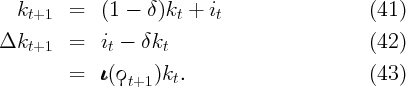
The capital accumulation equation can be rewritten as
3.2 Dynamics of Δϙ
To construct a phase diagram involving ϙ, we need to transform our
equation (33) for the dynamics of λ into an equation for the
dynamics of ϙ. As a preliminary, define the proportional change in
the after-tax price of capital as
Recalling that  t+1 = Δ
 t+1 +
t+1 +  t, dividing both sides of (33) by
  t
yields
t
yields
Now assuming that Δϙt+1, ∇ t+1, r, and jtk are all ‘small’ so that
their interactions are approximately 0, we have
t+1, r, and jtk are all ‘small’ so that
their interactions are approximately 0, we have
Simplifying further, if the pretax price of capital is unchanging
pt+1 = pt and δ = 0, (45) becomes
where combines the effects of the corporate tax and the investment tax
credit into a single tax term.
3.3 Results
Figure 1 presents two versions of the phase diagram, one for k and
λ and one for k and ϙ.
For most purposes, ϙ diagram is simpler, because our facts about
the  function imply that the Δkt+1 = 0 locus is always a horizontal
line at ϙ = 1. This is because ϙ = 1 always corresponds to the
circumstance in which the value of a unit of capital inside the firm,
λ, matches the after-tax cost of a unit of capital,
function imply that the Δkt+1 = 0 locus is always a horizontal
line at ϙ = 1. This is because ϙ = 1 always corresponds to the
circumstance in which the value of a unit of capital inside the firm,
λ, matches the after-tax cost of a unit of capital,  , so ϙ = 1 is the
only value of ϙ at which the firm does not wish to change size
(Δkt+1 = 0).
, so ϙ = 1 is the
only value of ϙ at which the firm does not wish to change size
(Δkt+1 = 0).
The slope of the 𝔼[Δϙt+1] locus is easiest to think about near the
steady state value of k where we can approximate jtk ≈ 0. Pick a
point on the 𝔼[Δϙt+1] = 0 locus. Now consider a value of ϙ that is
slightly larger. From (46), at the initial value of k we would have
𝔼[Δϙt+1] > 0. Thus, the value of k corresponding to 𝔼[Δϙt+1] = 0
must be one that balances the higher ϙ by a higher value
of fk, which is to say a lower value of k. This means that
higher ϙ will be associated with lower k so that the locus is
downward-sloping.
For appropriate choices of parameter values the problem
satisfies the usual conditions for saddle point stability and
will therefore have a saddle path solution, as depicted in the
diagram.
The λ diagram is virtually indistinguishable from the ϙ
diagram; the only difference is that the Δkt+1 locus is located
at the point λ =  (i.e. the marginal value of investment is
equal to the price of a unit of investment). The distinction
between the diagrams reflects the fact that an increase in the
investment tax credit will result in a rise in the steady-state value
of k which implies a fall in the pretax marginal product of
capital.
(i.e. the marginal value of investment is
equal to the price of a unit of investment). The distinction
between the diagrams reflects the fact that an increase in the
investment tax credit will result in a rise in the steady-state value
of k which implies a fall in the pretax marginal product of
capital.
4 Dynamics
4.1 Steady State
The key to understanding the model’s dynamics is understanding
the steady state toward which it is heading, then understanding how
it gets there.
The key to the steady state, in turn, is that the capital stock will
eventually be able to reach a point where jk = ji = 0.
4.2 A Positive Shock to Productivity
Suppose that the production function for the firm suddenly,
permanently, and unexpectedly improves; specifically, suppose that
leading up to period t the firm was in steady state, but in periods
t + 1 and beyond the production function will be f≥(k) = Ψf<(k)
for some Ψ > 1 where f< and f≥ indicate the production functions
before and after the increase in productivity.
Note first that none of the tax terms has changed, and in the long
run there is nothing to prevent the firm from adjusting its
capital stock to the point consistent with the new level of
productivity and then leaving it fixed there so that jk = ji = 0.
Thus (46) implies that at the new steady state  ≥ we will have
r
≥ we will have
r =
=  -1f≥k(
 ≥) = Ψ-1f<k(
 ≥) which implies
  ≥ >
≥ >  <, since the
steady state value of ϙ never changes:
<, since the
steady state value of ϙ never changes:  ≥ =
≥ =  < = 1. That is, with
higher productivity, the equilibrium capital stock is larger, but the
equilibrium tax adjusted marginal product of capital is the
same.
< = 1. That is, with
higher productivity, the equilibrium capital stock is larger, but the
equilibrium tax adjusted marginal product of capital is the
same.
Obviously in order to get from an initial capital stock of  < to
a larger equilibrium capital stock of
< to
a larger equilibrium capital stock of  ≥ the firm will need
to engage in investment in excess of the depreciation rate,
incurring costs of adjustment. In the absence of a change in the
environment, expected costs of adjustment will always be declining
toward zero, because the firm’s capital stock will always be
moving toward its equilibrium value in which those costs are
zero.
≥ the firm will need
to engage in investment in excess of the depreciation rate,
incurring costs of adjustment. In the absence of a change in the
environment, expected costs of adjustment will always be declining
toward zero, because the firm’s capital stock will always be
moving toward its equilibrium value in which those costs are
zero.
So we can tell the story as follows. Suppose that leading up to
period t the firm was in its steady-state. When the productivity
shock occurs, fk jumps up. jtk had been zero (because the firm was
at steady state), but now having more capital reduces the
magnitude of future adjustment costs (the firm knows that its old
steady-state capital stock is now too small, so it will have to be
engaging in ι > 0 for a while), so jtk becomes negative. The
combination -1ftk - jtkβ therefore becomes a larger positive
number, so at the initial level of ϙ the RHS of (46) would imply
𝔼[Δϙt+1] less than zero, so the new 𝔼[Δϙt+1] = 0 locus must be
higher (the equilibrating value of ϙ is higher). The saddle path is
therefore also higher. So ϙ, and therefore ι, jump up instantly when
the new higher level of productivity is revealed, corresponding also
to an immediate increase in the firm’s share price (the marginal
valuation of an additional unit of capital), since has not
changed.
The phase diagrams with the saddle paths before and after the
productivity increase together with the impulse response functions
are plotted in figure 2.
4.3 A Permanent Tax Cut
Again starting from the steady state equilibrium, suppose
unexpectedly and permanently decreases, which could happen
because of a cut in corporate taxes or an increase in the ITC. (46)
implies that in steady state
Dynamically, the story is as follows. (46) implies that following
the tax change the 𝔼[Δϙt+1] = 0 locus must be higher because at
any given ϙ the -fk∕ term is a larger negative number, while at
the initial k the jtk term is also now negative; so the 𝔼[Δϙt+1] = 0
locus shifts up.
In contrast to the case with a productivity shock, the equilibrium
marginal product of capital will be lower than before. Arbitrage
equalizes the after-tax marginal product of capital with the interest
rate, but with a lower tax rate that will occur at a higher level of
capital.
Notice that the qualitative story is the same whether the change
in is due to a permanent reduction in the corporate tax rate
(increase in η) or a permanent increase in the investment tax credit
(reduction in ζ). In either case, ϙ and investment jump upward at
time t and then gradually decline back toward their original
steady-state levels.
There is, however, one interesting distinction between a decrease
in due to a reduction in corporate taxes and a decrease caused
by an increase in  . Since λ = ζϙ, an increase in
  reduces
ζ and therefore reduces the equilibrium value of λ, while a
change in η has no effect on equilibrium λ. This reflects a
subtle distinction. λ is the after-tax marginal value of extra
capital, and the equilibrium in this model will occur at the
point where that marginal value is equal to the marginal cost.
Changing
reduces
ζ and therefore reduces the equilibrium value of λ, while a
change in η has no effect on equilibrium λ. This reflects a
subtle distinction. λ is the after-tax marginal value of extra
capital, and the equilibrium in this model will occur at the
point where that marginal value is equal to the marginal cost.
Changing  changes that marginal cost, so it changes the
equilibrium after-tax marginal value. Changing η does not
change the marginal cost of capital, so the equilibrium after-tax
marginal value of capital is unchanged. The marginal product of
capital is lower after a tax cut (equilibrium fk is smaller),
but that is exactly counterbalanced by the larger value of η
so that ηfk is unchanged in the long run by the change in
η.
changes that marginal cost, so it changes the
equilibrium after-tax marginal value. Changing η does not
change the marginal cost of capital, so the equilibrium after-tax
marginal value of capital is unchanged. The marginal product of
capital is lower after a tax cut (equilibrium fk is smaller),
but that is exactly counterbalanced by the larger value of η
so that ηfk is unchanged in the long run by the change in
η.
The phase diagrams with the saddle paths before and after the
corporate tax reduction and the ITC increase together with the
impulse response functions are respectively plotted in figures 3 and
4.
4.4 A Future Shock to Productivity
Now consider a circumstance where the firm knows that at some
date in the future, t + n, the level of productivity will increase so
that f≥t+n = Ψf<t+n for Ψ > 1.
The long run steady state is of course the same as in the
example where the increase in productivity is immediately
effective.
To determine the short run dynamics, notice several things. First,
there can be no anticipated big jumps in the share price of the firm
(the marginal productivity of capital inside the firm). Thus, if the
productivity jump occurs in period t + n and the time periods are
short enough, we must have
But because the equilibrium capital stock is larger, we know that
j≥t+nk < 0 and will stay negative thereafter (asymptoting
to zero from below). This reflects the fact that if you know
you will need higher capital in the future, the most efficient
way to minimize the cost of obtaining that capital is to
gradually start building some of it even before you need it,
rather than trying to do it all at once. Note further that before
period t + n the model behaves according to the equations
of motion defined by the problem under the < parameter
values,
while at t + n and after it behaves according to the new ≥ equations
of motion.
Putting all this together, the story is as follows. Upon
announcement of the productivity increase, λ jumps to the level
such that, evolving exactly according to its < equations of motion, it
will arrive in period t + n at a point exactly on the saddle path
of the model corresponding to the ≥ equations of motion.
Thereafter it will evolve toward the steady state, which will be
at a higher level of capital than before,  ≥ >
≥ >  <, because
the greater productivity justifies a higher equilibrium capital
stock.
<, because
the greater productivity justifies a higher equilibrium capital
stock.
Thus, λ jumps up at time t, evolves to the northeast until time
t + n, and thereafter asymptotes downward toward the same
equilibrium value it had originally before the productivity change.
Since has not changed, the dynamics of ϙ and ι are the same as
those of λ.
4.5 A Future Tax Cut
Consider now the consequences if a tax cut is passed at date t that
will become effective at date t + n > t.
Inspection of (46) might suggest that the effects of a future tax
cut would be identical to the effects of a future increase in fk, since
the terms enter multiplicatively via -1fk. And indeed, with respect
to the dynamics of λ the two experiments are basically the same.
And of course the steady-state value of ϙ is always equal to
one.
During the transition, however, ϙ has interesting dynamics. From
periods t to t + n - 1, taxes and the after-tax marginal product of
capital do not change, and so the dynamics of ϙ are basically the
same as those of λ. But between t + n- 1 and t + n, λ cannot jump
but -1 does jump, which implies that ϙ must jump (so there is a
predictable change in ϙ).
Dynamics of investment are determined by dynamics of ϙ, so the
path of ι is: At t, a discrete jump up; between t and t + n, a gently
rising path; between t + n- 1 and t + n, an upward jump; and after
t + n, a path that asymptotes downward toward the steady state
level of investment.
The steady-state effects on λ are of course determined by the
same considerations as apply to the unanticipated tax cut, so they
depend on whether the tax change is a drop in (1 -η) or an increase
in  .
.
References
Abel, Andrew B. (1981): “A Dynamic Model of
Investment and Capacity Utilization,” Quarterly Journal of
Economics, 96(3), 379–403.
Hayashi, Fumio (1982): “Tobin’s Marginal Q and Average
Q: A Neoclassical Interpretation,” Econometrica, 50(1),
213–224.
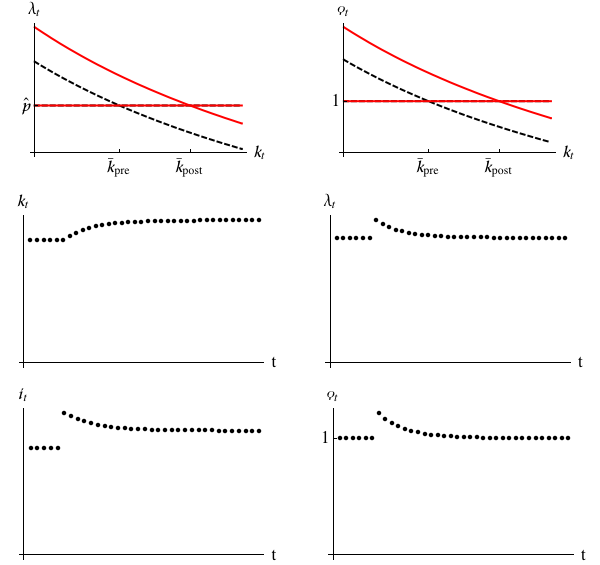
| Figure 2: | Increase in productivity: phase diagrams with saddle paths
(dashed-black and continuous-red lines respectively pre and post the
productivity increase) and impulse response functions |
|
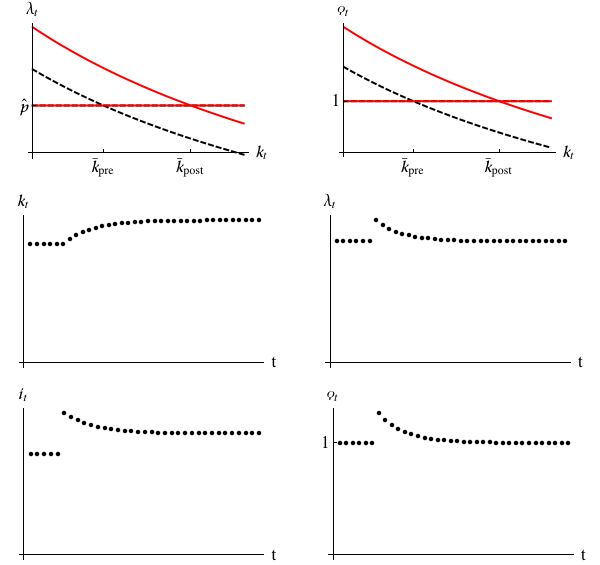
| Figure 3: | Corporate tax reduction: phase diagrams with saddle paths
(dashed-black and continuous-red lines respectively pre and post the
corporate tax reduction) and impulse response functions |
|
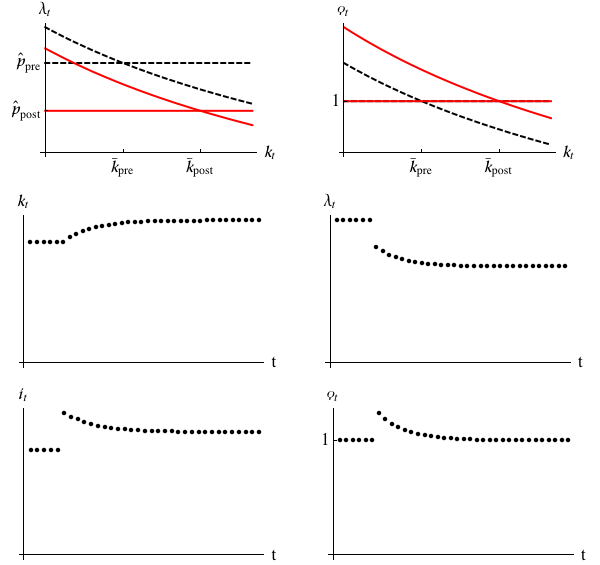
| Figure 4: | ITC increase: phase diagrams with saddle paths (dashed-black and
continuous-red lines respectively pre and post the ITC increase) and impulse
response functions |
|

 = Cost of investment after ITC
  t = ζpt
  t+1β
t+1β ![[ ]
∑∞
et(kt) = max 𝔼t βs- t (πs - xs) . (1)
{i}∞t
s=t](qModel4x.png)

![⌊ ∞ ⌋
∑ s- ˆt
et(kt) = max πt - xt + β𝔼t ⌈max∞ β (πs - xs )⌉ (3)
{it} {i}ˆt ˆ
s= t
= max πt - xt + β𝔼t [et+1(kt ℸ + it)] (4)
{it}](qModel7x.png)
![( =it )
{ ◜ ---◞◟ ---◝ }
et(kt) = max πt - (kt+1 - ktℸ +j (kt+1 - ktℸ, kt) )ˆpt+1β + β 𝔼t[et+1 (kt+1)]
{kt+1}( )
(5)](qModel8x.png)
![i k
(1 + jt)ˆpt+1β = β𝔼t [et+1(kt+1 )]. (6)](qModel9x.png)
![k k k k
et(kt) = ηf (kt ) - jtpˆt+1 β + ℸ β𝔼t [et+1(kt+1 )] (7)
ek(kt) = ηf k(kt ) + ((1 + ji)ℸ - jk)pˆt+1 β (8)
t t t](qModel10x.png)
![(1 + jit) ˆpt+1 = 𝔼t [ηf k (kt+1) + (ℸ + ℸjit+1 - jkt+1 )ˆpt+2β ] (9)
k i i k
= 𝔼t [ηf (kt+1) + (ℸ + jt+1 - δj t+1 - j t+1 )ˆpt+2β(1]0.)](qModel11x.png)


![(1 + jit)ˆpt+1 = 𝔼t [ηf k(kt+1 ) + (ℸ + jit+1 + (ω ∕2)ι2t+1)pˆt+2 β(].25)](qModel16x.png)
![k
pˆt+1 = 𝔼t[ηf (kt+1 ) + ℸ ˆpt+2 β]. (26)](qModel17x.png)
![k
ˆp = 𝔼t[ηf (kt+1 )] + ˆpβ ℸ. (27)
(r + δ) ˆp ≈ 𝔼t[ηf k(kt+1 )]. (28)](qModel19x.png)

![λt = ηf k(kt) + βℸ 𝔼t [λt+1] - jkt ˆpt+1β (30)
k k
≈ ηf (kt) + (1 - δ - r)𝔼t [λt + λt+1 - λt] - jtpˆt+1(3β1)
k k
= ηf (kt) + (1 - δ - r)𝔼t [λt + Δ λt+1] - jt ˆpt+1 β(32)
(r + δ )λt ≈ ηf k(kt) + 𝔼t[Δ λt+1 ] - jk ˆpt+1β (33)
t](qModel24x.png)
![[ ]
𝔼t[Δ λt+1 ] ≈ rλt - ηf k(kt) - jkt ˆpt+1 β - δλt . (34)](qModel25x.png)
![[ ]
rλt < ηf k(kt) - pˆt+1 βjkt - δ λt . (35)](qModel26x.png)




![[( ) ( ) ]
k k λt+1- λt-
(r + δ)ϙt = ηf (kt )∕ˆpt - j t (Δ ˆpt+1 + ˆpt)β ∕ˆpt + 𝔼t -
[ ( ˆpt ˆpt) ]
k k λt+1
≈ ηf (kt )∕ˆpt - (1 + ∇ pˆt+1 )jt β + 𝔼t -----(1 + ∇ ˆpt+1 ) - ϙt
[ pˆt+1 ]
= ηf k(k )∕ˆp - (1 + ∇ pˆ )jkβ + 𝔼 (1 + ∇ ˆp )ϙ - ϙ
t t t+1 t t t+1 t+1 t](qModel39x.png)
![[ ]
𝔼t Δ ϙt+1 ≈ (r + δ - ∇ ˆpt+1 )ϙt - [ηf k(kt) ∕ˆpt - jkt β]. (45)](qModel41x.png)
![k k
𝔼t [Δ ϙt+1] ≈ rϙt - f (kt)∕Tt + jt β (46)](qModel42x.png)