 February 7, 2021, Christopher D. Carroll PerfForesightCRRA
February 7, 2021, Christopher D. Carroll PerfForesightCRRA
This handout solves the problem of a perfect foresight consumer with
intertemporally separable CRRA utility  who discounts
future utility geometrically by a factor
who discounts
future utility geometrically by a factor  per period. The finite horizon
solution, whose last period is
per period. The finite horizon
solution, whose last period is  , extends to the infinite horizon case if intuitive
‘impatience’ and ‘finite human wealth’ conditions hold.
, extends to the infinite horizon case if intuitive
‘impatience’ and ‘finite human wealth’ conditions hold.
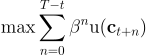
The consumer’s problem in period  is to
is to
 | (1) |
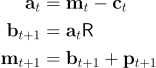
subject to the constraints
 | (2) |
where  is ‘permanent labor income,’ which always grows by a factor
 :
:
 | (3) |
It will be convenient to think of both market resources  and permanent
noncapital (labor) income
and permanent
noncapital (labor) income  as state variables in this problem. Bellman’s
equation is
as state variables in this problem. Bellman’s
equation is
 | (4) |
The first order condition for this maximization is
 | (5) |
and the Envelope theorem tells us that
 | (6) |
But the right hand sides of (5) and (6) are identical, so
 | (7) |
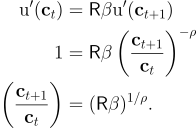
and similar logic tells us that  which (substituting
 for
for  in (6)) gives us the Euler equation for consumption:
 | (8) |
Thus, consumption grows in every period by a factor  , where we
use the Old English letter
, where we
use the Old English letter  to measure what we will call the “absolute
patience” factor. Specifically, if
to measure what we will call the “absolute
patience” factor. Specifically, if
 | (9) |
we will say that the consumer exhibits ‘absolute impatience’ because this is the
condition that guarantees that the level of consumption will be falling
(and what better definition of absolute impatience could there be than
deliberately spending so much that you will have to cut your spending in the
future?). If  the consumer exhibits “absolute patience” (the consumer
wants to defer resources into the future in order to achieve consumption
growth).
the consumer exhibits “absolute patience” (the consumer
wants to defer resources into the future in order to achieve consumption
growth).
The Intertemporal Budget Constraint tells us that the present discounted value of consumption must match the PDV of total resources:
 | (10) |
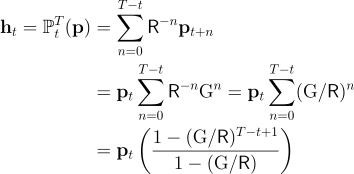
Fact ![[FinSum ]](PerfForesightCRRA25x.svg) from MathFacts can be used to show that the PDV of labor
income (also called ‘human wealth’
from MathFacts can be used to show that the PDV of labor
income (also called ‘human wealth’  ) is
) is
 | (11) |
while the PDV of consumption is
![T∑ − t
T − n
ℙ t (c) = R ct+n
n=0
T − t
∑ − n 1∕ρ n
= R ct((R β ) )
n=0
T− t
∑ − 1 1∕ρ n
= ct [R (Rβ ) ]
n=0
( − 1 1∕ρ T− t+1 )
= c 1-−--[R----(Rβ-)---]------ .
t 1 − [R − 1(Rβ )1∕ρ]](PerfForesightCRRA28x.svg) | (12) |
We can solve the model by combining (12) and (11) using (10) to obtain:
![⌊ ⌋
◜---------≡◞h◟t--------◝
( 1 − [R − 1 (Rβ )1∕ρ] ) | ( 1 − (G ∕R )T − t+1 ) |
ct = ------------------------- || bt + pt ------------------- || .
1 − [R − 1(R β )1∕ρ]T− t+1 ⌈ 1 − (G ∕R ) ⌉
◟------------◝◜ ------------◞
≡κt ---------------- ----------------
◟ ◝◜ ◞
≡ooot](PerfForesightCRRA29x.svg) | (13) |
where  is the marginal propensity to consume (MPC) out of overall (human
plus nonhuman) wealth
is the marginal propensity to consume (MPC) out of overall (human
plus nonhuman) wealth  .
.
In order to apply ![[InfSum ]](PerfForesightCRRA32x.svg) to move to the infinite-horizon case (
to move to the infinite-horizon case ( ),
we need to impose the condition
),
we need to impose the condition
 | (14) |
Why? Because if income were expected to grow at a rate greater than the interest rate forever, then the PDV of future income would be infinite; with infinite human wealth, the problem has no well-defined solution. We henceforth call (14) the Finite Human Wealth Condition (FHWC).
Similarly, if consumption starts at a positive level and grows by the factor
 , in order for the PDV of consumption to be finite we must
impose:
, in order for the PDV of consumption to be finite we must
impose:
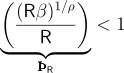 | (15) |
and we will henceforth call  the ‘return patience factor’ whose log is the
‘return patience rate’
the ‘return patience factor’ whose log is the
‘return patience rate’  (
( is the lower-case version of
  ) and
what (15) says is that the desired growth rate of consumption must be less than
the interest rate in order for the model to have a well-defined solution. This
condition therefore imposes a requirement that ‘impatience’ be greater than
some minimum amount. (For (much) more on the various definitions of
impatience used in this handout, their implications, and parallel conditions for
models with uncertainty, see Carroll (Forthcoming)).
) and
what (15) says is that the desired growth rate of consumption must be less than
the interest rate in order for the model to have a well-defined solution. This
condition therefore imposes a requirement that ‘impatience’ be greater than
some minimum amount. (For (much) more on the various definitions of
impatience used in this handout, their implications, and parallel conditions for
models with uncertainty, see Carroll (Forthcoming)).
If both the RIC and the FHWC hold, then the model has a well-defined infinite horizon solution,1 as can be seen by realizing that
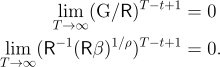 | (16) |
Substituting these zeros into (13) yields
![[ ( ) ]
( ) p
ct = 1 − R− 1(R β)1∕ρ bt + ------t-----
1 − (G ∕R )
( )
= 1 − R− 1(R β)1∕ρ (mt − pt + ht )
( )
R − (Rβ )1∕ρ
= -------------- ooot
-------R -------
◟ ◝◜ ◞
≡ κ](PerfForesightCRRA42x.svg) | (17) |
where  is the consumer’s ‘overall’ or ‘total wealth,’ the sum of human and
nonhuman wealth, and
is the consumer’s ‘overall’ or ‘total wealth,’ the sum of human and
nonhuman wealth, and  is the infinite-horizon marginal propensity to
consume.
is the infinite-horizon marginal propensity to
consume.
Now consider the question ‘What is the level of  that will leave total wealth
intact, allowing the same value of consumption in period
that will leave total wealth
intact, allowing the same value of consumption in period  and forever after
(that is, allowing
and forever after
(that is, allowing  )?’
)?’
The intuitive answer is that the wealth-preserving level of spending is exactly equal to the (properly conceived) interest earnings on one’s total wealth. We call this the ‘sustainable’ level of consumption.
Because human wealth is exactly like any other kind of wealth in this perfect
foresight framework, it is possible to work directly with the level of total wealth
 to find the sustainable level of spending. Suppose we assume the consumer
will spend fraction
to find the sustainable level of spending. Suppose we assume the consumer
will spend fraction  of total wealth in each period; the
  that leaves wealth
intact will be given by
that leaves wealth
intact will be given by  in
in
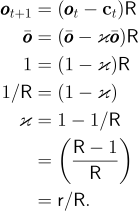 |
Thus, the consumer can spend only the interest earnings  on wealth, divided
by the return factor
on wealth, divided
by the return factor  . (The division occurs because the requirement
is to be able to spend the same amount next period, so you need to
account for the time cost of today’s spending by dividing by
. (The division occurs because the requirement
is to be able to spend the same amount next period, so you need to
account for the time cost of today’s spending by dividing by  which
connects today’s spending to tomorrow’s wealth.) Note that the coefficient
multiplying total wealth in (17) is also divided by
which
connects today’s spending to tomorrow’s wealth.) Note that the coefficient
multiplying total wealth in (17) is also divided by  . Thus, whether
the consumer is spending more than the sustainable amount, exactly
the sustainable amount, or less than the sustainable amount depends
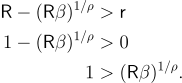
upon whether the numerator in (17) is greater than, equal to, or less
than
. Thus, whether
the consumer is spending more than the sustainable amount, exactly
the sustainable amount, or less than the sustainable amount depends
upon whether the numerator in (17) is greater than, equal to, or less
than  . As noted before, the consumer will be ‘absolutely impatient’
if
. As noted before, the consumer will be ‘absolutely impatient’
if
 |
Finally, if  (which is to say, the interest rate exactly offsets
the time preference rate), then
(which is to say, the interest rate exactly offsets
the time preference rate), then  regardless of the value
of
regardless of the value
of  so that the consumer is ‘poised’ on the knife-edge between
patience and impatience. We refer to such a consumer as ‘absolutely
poised.’ Similarly, we say that a consumer for whom
so that the consumer is ‘poised’ on the knife-edge between
patience and impatience. We refer to such a consumer as ‘absolutely
poised.’ Similarly, we say that a consumer for whom  is ‘return
poised.’2
is ‘return
poised.’2
Equation (17) can be simplified into something a bit easier to handle by
making some approximations. If  , then we can use facts from
MathFacts to discover that
, then we can use facts from
MathFacts to discover that
![1∕ρ
log (Rβ ) ∕R = (1∕ρ )(log R + log[1∕ (1 + 𝜗 )]) − log R
= (1∕ρ )(log(1 + r) + log 1 − log (1 + 𝜗)) − log R
≈ ρ− 1(r − 𝜗 ) − r
(Rβ )1∕ρ∕R ≈ 1 + (ρ − 1(r − 𝜗) − r).](PerfForesightCRRA65x.svg) |
Substituting this into (17) gives
 | (18) |
From this we can see again that whether the consumer is return patient, return
poised, or return impatient depends on the relationship between  and
and  .
Note also that if
.
Note also that if  then the consumer is infinitely averse to changing the
level of consumption, and so once again the consumer spends exactly the
sustainable amount. (This consumer is ‘absolutely poised’ but ‘return
impatient’).
then the consumer is infinitely averse to changing the
level of consumption, and so once again the consumer spends exactly the
sustainable amount. (This consumer is ‘absolutely poised’ but ‘return
impatient’).
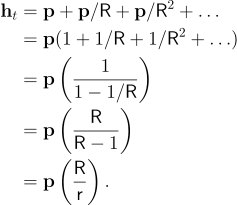
Now a brief digression on what ‘income’ means in this model. Suppose
for simplicity that the consumer had no capital assets (‘bank balances’
 ), and suppose that income was expected to stay constant at level
 forever. In this case human wealth would be:
 |
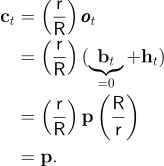
We found in equation (2) that the level of consumption that leaves ‘wealth’  intact was
 | (19) |
So in this case, spending the ‘interest income on human wealth’ corresponds to
spending exactly your labor income. This seems less mysterious if you think of
income  as the ‘return’ on your human capital, which is an asset whose value
is
as the ‘return’ on your human capital, which is an asset whose value
is  . If you ‘capitalize’ your stream of income using the interest factor
 and then spend the interest income on the capitalized stream, it
stands to reason that you are spending the flow of income from that
source.
and then spend the interest income on the capitalized stream, it
stands to reason that you are spending the flow of income from that
source.
With constant  we can rewrite (18) as
 | (20) |
 appears three times in this equation, which correspond (in order) to
the income effect, the substitution effect, and the human wealth effect.
To see this, note that an increase in the first
appears three times in this equation, which correspond (in order) to
the income effect, the substitution effect, and the human wealth effect.
To see this, note that an increase in the first  reflects an increase in
the payout rate on total wealth (set
reflects an increase in
the payout rate on total wealth (set  and refer to our formula
above for
and refer to our formula
above for  , realizing that for small
  ,
,  .) That is, it simply
reflects the consequence for consumption of an increase in interest income
– so it captures the ‘income effect’ of interest rates. The second term
corresponds to the subsitution effect, as can be seen from its dependence on the
intertemporal elasticity of substitution
.) That is, it simply
reflects the consequence for consumption of an increase in interest income
– so it captures the ‘income effect’ of interest rates. The second term
corresponds to the subsitution effect, as can be seen from its dependence on the
intertemporal elasticity of substitution  . Finally, the
  term
clearly corresponds to human wealth, and therefore the sensitivity of
consumption to
term
clearly corresponds to human wealth, and therefore the sensitivity of
consumption to  coming through this term corresponds to the human wealth
effect.
coming through this term corresponds to the human wealth
effect.

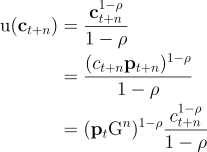
The whole problem can be restated more simply by ‘dividing through’ by the
level of permanent income before solving. Hereafter, nonbold variables will be
the normalized bold-letter equivalent, e.g.  , and note that if
 then from the standpoint of date
  ,
,
 | (21) |
which means that
 | (22) |
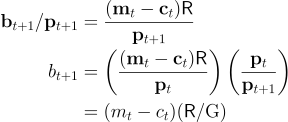
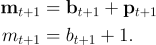
Furthermore, the accumulation equations can be rewritten by dividing both
sides by  :
:
 | (23) |
 | (24) |
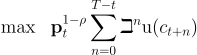
Now if we define  and
and  , the original problem can be
rewritten as:
, the original problem can be
rewritten as:
 | (25) |
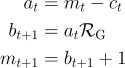
subject to the constraints
 | (26) |
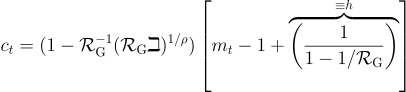
and we can go through the same steps as above to find that the solution is
 | (27) |
subject to the ‘finite human wealth’ condition
 | (28) |
which is the same condition (14) as above, and also subject to the ‘return impatience condition’
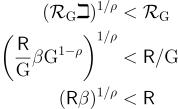 | (29) |
which is also the same as above in (15).
Now note that (27) can be rewritten
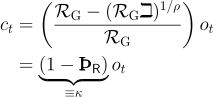 | (30) |
where  is the consumer’s total wealth-to-permanent-labor-income ratio, and
 is the ‘marginal propensity to consume’ out of wealth.
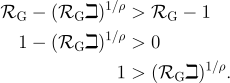
As before, whether  is rising or falling depends upon the relationship
between
is rising or falling depends upon the relationship
between  and
and  . A consumer will be drawing down his
wealth-to-income ratio if
. A consumer will be drawing down his
wealth-to-income ratio if
 | (31) |
Now substituting the definitions of  and
and  we see that whether
  is
rising or falling depends on whether
is
rising or falling depends on whether
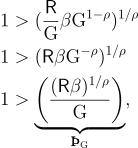 | (32) |
where  is the ‘growth patience factor.’ We call (32) the ‘growth impatience condition’
(GIC),3
and we say that the consumer is ‘growth impatient’ if (32) holds.
is the ‘growth patience factor.’ We call (32) the ‘growth impatience condition’
(GIC),3
and we say that the consumer is ‘growth impatient’ if (32) holds.
Thus, whether the consumer is patient or impatient in the sense of
building up or drawing down a wealth-to-income ratio depends on whether
the growth rate of labor income is less than, equal to, or greater than
the growth rate of consumption. Analogously to our earlier usages, a
consumer for whom  (equivalently,
  ) would be ‘growth
poised.’
) would be ‘growth
poised.’
To get the intuition for this, consider the case of a consumer with no
nonhuman wealth,  . This consumer’s absolute level of consumption will
grow at
. This consumer’s absolute level of consumption will
grow at  and absolute level of income grows at
  , but the PDV of
future consumption and future income must be equal. If income is growing faster
than consumption but has the same PDV, consumption must be starting out at a
level higher than income - which is the sense in which this consumer
is impatient (spending more than his income). ‘Growth impatience’ is
therefore the condition that causes consumers with no assets to want to
borrow.
, but the PDV of
future consumption and future income must be equal. If income is growing faster
than consumption but has the same PDV, consumption must be starting out at a
level higher than income - which is the sense in which this consumer
is impatient (spending more than his income). ‘Growth impatience’ is
therefore the condition that causes consumers with no assets to want to
borrow.
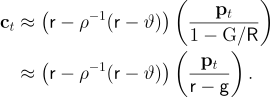
We can now apply the model to answer our first useful question: How large does the model imply the ‘human wealth effect’ is?
For simplicity, assume that  . Then the original version of the
approximate formula (18) tells us that the level of consumption will be given
by:
. Then the original version of the
approximate formula (18) tells us that the level of consumption will be given
by:
 | (33) |
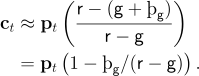
We are interested only in calibrations of the model in which the consumer is
‘growth impatient’ so that  so if we define the rate of growth
impatience as
so if we define the rate of growth
impatience as
 | (34) |
we can write this as
 | (35) |
Remembering that imposition of the growth impatience condition is equivalent
to assuming  , while the FHWC requires
  , it is clear that the
expression
, it is clear that the
expression  will be positive: The consumer will spend more than
his permanent labor income.
will be positive: The consumer will spend more than
his permanent labor income.
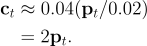
Now suppose we choose plausible values for  .
Then (33) becomes:
.
Then (33) becomes:
 | (36) |
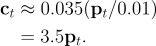
Now suppose the interest rate changes to  , while all other parameters
remain the same. Then (33) becomes:
, while all other parameters
remain the same. Then (33) becomes:
 | (37) |
The point of this example is that for plausible parameter values, the human wealth effect is enormously stronger than the income and substitution effects, so that we should see large drops in consumption when interest rates rise and conversely strong gains when interest rates fall. This is a summary of the main point of the famous paper by Summers (1981); Summers derives formulas for an economy with overlapping generations of finite-lifetime consumers, but those complications do not change the basic message.
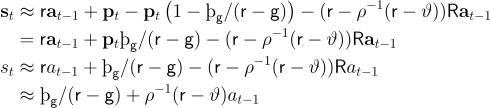
The level of saving can be defined as total income minus total consumption:
 | (38) |
but since
 | (39) |
this can be rewritten as
 | (40) |
(where the last approximations come from the assumptions that  ) and
that
) and
that  is ‘small.’ The saving rate (for which we use the letter
 to distinguish it from
  above) is the ratio of saving to total income (not
just labor income):
above) is the ratio of saving to total income (not
just labor income):
 | (41) |
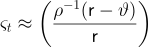
The first thing to notice about this expression is that as  approaches
infinity, the saving rate asymptotes to
approaches
infinity, the saving rate asymptotes to
 | (42) |
and whether the saving rate is positive or negative depends on whether the consumer is absolutely impatient, absolutely poised, or absolutely patient.4
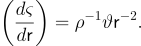
Finally, if we rewrite this as
 | (43) |
then it is apparent that the response of the saving rate to the interest rate is
 | (44) |
If we consider almost any plausible configuration of parameter values, say
 and
and  , this translates to a very large response of the saving
rate with respect to
, this translates to a very large response of the saving
rate with respect to  (in the case of the parameter values mentioned above,
 ).
).
Consider first a circumstance in which the RIC holds ( ). In this case, the
perfect foresight unconstrained model does not have a sensible solution because
human wealth is infinite while the model implies that the optimal policy is to
consume a positive proportion of human wealth.
). In this case, the
perfect foresight unconstrained model does not have a sensible solution because
human wealth is infinite while the model implies that the optimal policy is to
consume a positive proportion of human wealth.  is not a useful
(or plausible!) solution.
is not a useful
(or plausible!) solution.
The alternative case is when the RIC fails ( ). Here, the only way to
make sense of the model is to think about the limit of the finite horizon model as
the horizon extends to infinity. This is because behavior reflects a competition
between two pathologies that characterize the infinite horizon solution: It
exhibits a limiting MPC of zero out of total wealth, which includes human
wealth – which approaches infinity. A limiting solution of
). Here, the only way to
make sense of the model is to think about the limit of the finite horizon model as
the horizon extends to infinity. This is because behavior reflects a competition
between two pathologies that characterize the infinite horizon solution: It
exhibits a limiting MPC of zero out of total wealth, which includes human
wealth – which approaches infinity. A limiting solution of  is
even less useful than
is
even less useful than  !
!
It turns out that the limiting solution is not ambiguous, however. The finite
horizon solution implies that consumption out of human wealth when the end of
life is  periods in the future is
![( (R − 1G )n+1 − 1 )
κnhn = -----------------------
[R− 1(R β)1∕ρ]n+1 − 1](PerfForesightCRRA156x.svg) | (45) |
whose limit is given by
![( − 1 n+1 )
---(R---G-)-------
nlim↑∞ κnhn = lni↑m∞ [R− 1(R β)1∕ρ]n+1
( )
1
= lim --------
n↑∞ ÞÞÞ (n+1)
G
= ∞](PerfForesightCRRA157x.svg) | (46) |
since the if the FHWC condition fails ( ) then if the RIC
  holds, the GIC
  must hold, which guarantees
  so that
  approaches zero as
Given the result from (8) that
 |
we can rewrite the value function as
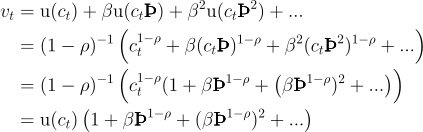 |
but since  ,5
this reduces to
,5
this reduces to
 | (48) |
where  is the discounted value of future consumption growth (that
is, the discounted value of the ratio of future consumption to today’s
consumption).
is the discounted value of future consumption growth (that
is, the discounted value of the ratio of future consumption to today’s
consumption).
Carroll (Forthcoming) shows (in an appendix) that  , which means
that we can write value as
, which means
that we can write value as
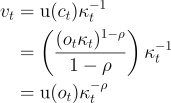 | (49) |
Carroll, Christopher D. (Forthcoming): “Theoretical Foundations of Buffer Stock Saving,” Quantitative Economics.
Summers, Lawrence H. (1981): “Capital Taxation and Accumulation in a Life Cycle Growth Model,” American Economic Review, 71(4), 533–544, http://www.jstor.org/stable/1806179.