 September 21, 2020, Christopher D. Carroll Romer86
September 21, 2020, Christopher D. Carroll Romer86
Romer (1986) relaunched the growth literature with a paper that presented a model of increasing returns in which there was a stable positive equilibrium growth rate that resulted from endogenous accumulation of knowledge. This was an important break with the existing literature, in which technological progress had largely been treated as completely exogenous.1
In Romer’s model, firm  ’s production function is of the form
 | (1) |
where aggregate output-augmenting technological progress is captured by  .
Its capital accumulates without depreciation,
.
Its capital accumulates without depreciation,
 | (2) |
Firms and individuals are distributed along the unit interval with a total mass of 1, as in Aggregation (and, importantly, there is no population growth). Thus, aggregate investment is, e.g.,
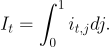 | (3) |
Romer assumes that the aggregate stock of knowledge in the economy is proportional to the cumulative sum of past aggregate investment
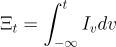 | (4) |
which, not coincidentally, is identical to the size of the aggregate capital stock,
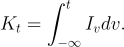 | (5) |
Romer makes the crucial assumption that the effect of the stock of knowledge determines productivity via
 | (6) |
where  . Thus, suppressing the
  subscript, the firm-level Cobb-Douglas
production function can be written
subscript, the firm-level Cobb-Douglas
production function can be written
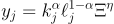 | (7) |
which is CRS at the firm level in  holding aggregate knowledge
  fixed.
Aggregate output is
 | (8) |
Dividing by the size of the labor force  (or, equivalently, normalizing to
 ), we have
 | (9) |
Now assume that households maximize a typical CRRA utility function, but
each household ignores the trivial effect its own investment decision has on
aggregate knowledge. Thus from the individual firm/consumer’s perspective, the
marginal product of capital is  . If we normalize the model by
assuming that the aggregate quantity of labor adds upt to
. If we normalize the model by
assuming that the aggregate quantity of labor adds upt to  , we can set
up and solve the Hamiltonian to obtain
, we can set
up and solve the Hamiltonian to obtain
 | (10) |
But if all households are identical and  , this means that aggregate
consumption per capita evolves according to
, this means that aggregate
consumption per capita evolves according to
 | (11) |
A balanced growth path can occur in this economy if  , in which
case
, in which
case
 | (12) |
so there is constant growth forever at a rate that depends on the degree of impatience and capital’s share in output.
Note finally that the steady-state growth rate that would be chosen by the social planner is
 | (13) |
because the social planner would take into account the fact that the externalities imply that there are higher returns to capital accumulation at the social level than at the individual level. Thus, this model implies that capital accumulation should be subsidized if the social planner wants to induce the private economy to move toward the social optimum.