 September 21, 2020, Christopher D. Carroll RebeloAK
September 21, 2020, Christopher D. Carroll RebeloAK
Rebelo (1991) examines a model in which a social planner maximizes
the discounted sum of utility in an economy with an  production
function:
production
function:
 | (1) |
subject to
 | (2) |
where we have assumed zero population growth and zero depreciation to make the analysis less cluttered.
This problem can be solved with the same Hamiltonian apparatus we
used to solve the Ramsey/Cass-Koopmans model. In particular, with
CRRA utility with risk aversion  one can show that optimal behavior
requires
one can show that optimal behavior
requires
 | (3) |
Note that this equation comes about because the marginal product of capital
in this model is always  , because
  . Note further that according
to this equation, the growth rate of consumption is always the same; unlike the
Cass-Koopmans model with a normal production function, this model has no
transitional dynamics.
. Note further that according
to this equation, the growth rate of consumption is always the same; unlike the
Cass-Koopmans model with a normal production function, this model has no
transitional dynamics.
We can also use (2) to obtain an expression for the steady-state growth rate:
 | (4) |
If the model has a steady-state growth rate of  , this equation
implies that
, this equation
implies that
 | (5) |
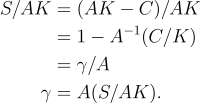
This is a model with a constant saving rate, because
 | (6) |
Thus, the steady-state growth rate in a Rebelo economy is directly proportional to the saving rate.
A further requirement for the Rebelo model to have a well-defined solution is that
 | (7) |
Recalling that  is effectively the real interest rate in this model, this
equation can be interpreted as the ‘impatience’ condition that we imposed in the
infinite horizon perfect foresight consumption model. In fact, the Rebelo
is effectively the real interest rate in this model, this
equation can be interpreted as the ‘impatience’ condition that we imposed in the
infinite horizon perfect foresight consumption model. In fact, the Rebelo  model is essentially just a way of reinterpreting the perfect foresight infinite
horizon consumption problem as a model for economic growth. The principal
distinction is that we usually use the perfect foresight infinite horizon
model to analyze circumstances where the agent has both labor and
capital income, whereas the Rebelo model rules out labor income by
assumption.
model is essentially just a way of reinterpreting the perfect foresight infinite
horizon consumption problem as a model for economic growth. The principal
distinction is that we usually use the perfect foresight infinite horizon
model to analyze circumstances where the agent has both labor and
capital income, whereas the Rebelo model rules out labor income by
assumption.