 September 21, 2020, Christopher D. Carroll Endogenous
September 21, 2020, Christopher D. Carroll Endogenous
The neoclassical theory of economic growth, as formulated by Solow (1956), and Cass (1965)-Koopmans (1965), attributes virtually all long-run growth to technological progress. The level of technology is taken to be an exogenously growing factor outside the model. So the baseline model of growth says that growth is caused mostly by a factor that is not in the model.
It is important to understand why Solow and others made this assumption.
The answer is that models of perfect competition are the simplest existing
models of firm behavior, with well-understood implications. But models with
perfect competition require constant returns to scale, and say that all factors of
production are paid their marginal product; and ![[EulersTheorem ]](Endogenous1x.svg) in
MathFacts says that the sum of the factor payments exhausts all output:
in
MathFacts says that the sum of the factor payments exhausts all output:
 | (1) |
Thus, the perfectly competitive firm has no money left over with which to finance basic research, invent patentable technologies, or do anything other than meet the payroll of production workers and pay the cost of capital. Thus, no firm can afford to pay for technological research, and there is therefore no alternative to the assumption that technological progress occurs exogenously.
This unsatisfactory situation persisted for a long time, but a famous paper by Paul Romer (1986) led the way to the formulation of a new generation of models that allow a role for investment in knowledge to affect growth.
The Romer paper spawned a great deal of further theoretical work by a host of others, but a penetrating paper by Sergio Rebelo (1991) provided a succinct summary of the key feature of all of these models. This handout summarizes the Rebelo point as interpreted by Barro and Sala-i-Martin (1995).
Rebelo’s key observation is as follows. Consider the class of models with a Cobb-Douglas aggregate production function in capital and labor:
 | (2) |
where no restriction is made on the  and
and  coefficients. (Recall that Solow,
Cass, and Koopmans all assumed
coefficients. (Recall that Solow,
Cass, and Koopmans all assumed  ; Rebelo is relaxing this
restriction). Now suppose for simplicity that in this economy saving is a constant
proportion of gross income. In continuous time, the growth of the capital stock is
given by
; Rebelo is relaxing this
restriction). Now suppose for simplicity that in this economy saving is a constant
proportion of gross income. In continuous time, the growth of the capital stock is
given by
 | (3) |
Suppose further that population growth is constant at
 | (4) |
and as usual define per-capita variables as the aggregate normalized by
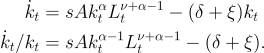
population, e.g.  . Then the aggregate per-capita accumulation
equation can be rewritten
. Then the aggregate per-capita accumulation
equation can be rewritten
 | (5) |
If this model has a steady-state growth rate, that rate must satisfy
 | (6) |
for some constant  . (The value of
  does not affect the conclusions from here
on, and so we will assume without loss of generality that
does not affect the conclusions from here
on, and so we will assume without loss of generality that  ). From (5), this
implies that
). From (5), this
implies that
 | (7) |
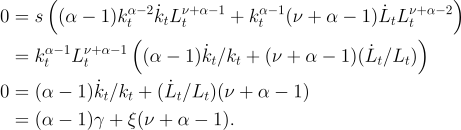
Take the time derivative of this equation to obtain
 | (8) |
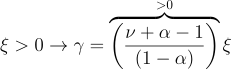
Using this equation, we can construct a complete catalog of the possible
circumstances under which steady-state growth  can be different from zero
endogenously.
can be different from zero
endogenously.
 (Constant Returns Models)
 (Solow case)
 : Rebelo (1991)
  growth model
 (Increasing Returns Models)



 which is not satisfied for any
 which can be satisfied for any
So whatever the details of endogenous growth models may be, in the end any model that generates perpetual growth without exogenous technological progress must be mathematically reducible to a form like that of either 1.b., 2.a.i., or 2.b.ii.
It is worth delving a bit further into why the Solow case cannot generate
perpetual growth. The answer can be understood using the Solow growth
accounting framework, which says that there are only three sources of long-run
growth: technology, labor, and capital. Thus, there are only two potential sources
of growth of output per unit of labor: Technology and an increase in
the capital/labor ratio. But if  , the gross marginal product of
capital approaches zero as the capital/labor ratio approaches infinity;
subtracting out depreciation, eventually the net marginal product of capital
becomes negative. Thus, capital accumulation can sustain growth only so
long.
, the gross marginal product of
capital approaches zero as the capital/labor ratio approaches infinity;
subtracting out depreciation, eventually the net marginal product of capital
becomes negative. Thus, capital accumulation can sustain growth only so
long.
The bottom line is that there are only two configurations of the model that are
capable of generating perpetual growth in a way that makes any sense: 1.b. (the
Rebelo  model) and 2.a.ii.
What this means is that any model that aims to permit perpetual long-run growth must ultimately boil down to a structure in which there are constant returns to scale for some set of factors of production that can jointly be accumulated forever.
Barro, Robert J., and Xavier Sala-i-Martin (1995): Economic Growth. McGraw-Hill, New York.
Cass, David (1965): “Optimum growth in an aggregative model of capital accumulation,” Review of Economic Studies, 32, 233–240.
Koopmans, Tjalling C. (1965): “On the concept of optimal economic growth,” in (Study Week on the) Econometric Approach to Development Planning, chap. 4, pp. 225–87. North-Holland Publishing Co., Amsterdam.
Rebelo, Sergio T. (1991): “Long-Run Policy Analysis and Long-Run Growth,” Journal of Political Economy, 99(3), 500–521.
Romer, Paul M. (1986): “Increasing Returns and Long Run Growth,” Journal of Political Economy, 94, 1002–37.
Solow, Robert M. (1956): “A Contribution to the Theory of Economic Growth,” Quarterly Journal of Economics, 70(1), 65–94.