 February 7, 2021, Christopher D. Carroll RandomWalk
February 7, 2021, Christopher D. Carroll RandomWalk
This handout derives the Hall (1978) random walk proposition for consumption.
The consumption Euler equation when future consumption is uncertain takes the form1
![u ′(ct) = βR 𝔼t[u ′(ct+1 )].](RandomWalk1x.svg) | (1) |
Suppose the utility function is quadratic:
 | (2) |
where  is the “bliss point” level of
consumption.2
Marginal utility is
is the “bliss point” level of
consumption.2
Marginal utility is
 | (3) |
and suppose further that  so that (1) becomes
![(/c − ct) = 𝔼t [(/c − ct+1) ]
𝔼t [ct+1 ] = ct.](RandomWalk7x.svg) | (4) |
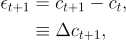
Defining the innovation to consumption as
 | (5) |
the random walk proposition is simply that the expectation of consumption changes is zero:
![𝔼 [Δc ] = 0.
t t+1](RandomWalk9x.svg) | (6) |
This means that no information known to the consumer when the
consumption choice  was made can have any predictive power for how
consumption will change between period
was made can have any predictive power for how
consumption will change between period  and
and  (or for any date beyond
 ).
).
Hall, Robert E. (1978): “Stochastic Implications of the Life-Cycle/Permanent Income Hypothesis: Theory and Evidence,” Journal of Political Economy, 96, 971–87, Available at http://www.stanford.edu/~rehall/Stochastic-JPE-Dec-1978.pdf.