 September 21, 2020, Christopher D. Carroll MathFactsList
September 21, 2020, Christopher D. Carroll MathFactsList
The following collection of facts is useful in many macroeconomic models. No proof is offered in most cases because the derivations are standard elements of prerequisite mathematics or microeconomics classes; this handout is offered as an aide memoire and for reference purposes.
Throughout this document, typographical distinctions should be interpreted as
meaningful; for example, the variables  and
and  are different from each other,
like
are different from each other,
like  and
and  .
.
Furthermore, a version of a variable without a subscript should be interpreted
as the population mean of that variable. Thus, if  is a stochastic variable,
then
is a stochastic variable,
then  denotes its mean value.
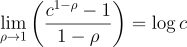
which follows from L’Hôpital’s rule1
because for any  the derivative exists,
 | (2) |
and  but
but  .
.
Thus, we can conclude that as  , the behavior of the consumer with
 becomes identical to the behavior of a consumer with
 .2
.2
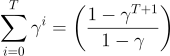
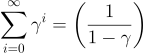
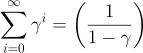
Sometimes economic models are written in continuous time and sometimes in
discrete time. Generically, there is a close correspondence between the two
approaches, which is captured (for example) by the future value of a series that
is growing at rate  .
.
 | (7) |
The words ‘corresponds to’ are not meant to imply that these objects are
mathematically identical, but rather that these are the corresponding ways in
which constant growth is treated in continuous and in discrete time; while for
small values of  they will be numerically very close, continuous-time
compounding does yield slightly different values after any given time interval
than does discrete growth (for example, continuous growth at a 10 percent rate
after 1 year yields
they will be numerically very close, continuous-time
compounding does yield slightly different values after any given time interval
than does discrete growth (for example, continuous growth at a 10 percent rate
after 1 year yields  while in discrete time we would write it as
 .)
.)
Many of the following facts can be interpreted as manifestations of the limiting relationships between continuous and discrete time approaches to economic problems. (The continuous time formulations often yield simpler expressions, while the discrete formulations are useful for computational solutions; one of the purposes of the approximations is to show how the discrete-time solution becomes close to the corresponding continuous-time problem as the time interval shrinks).
Fact 15. If from the viewpoint of period  the stochastic variable
  is
lognormally distributed with mean
is
lognormally distributed with mean  and variance
  ,
,  ,
then
,
then
![rt+1 r+ σ2∕2
𝔼t[e ] = e r](MathFactsList58x.svg) | (16) |
Fact 16. If from the viewpoint of period  the stochastic variable
  is lognormally distributed with mean
  and variance
  ,
,
 , then
![rt+1 − σ2r∕2+ σ2r∕2 0
𝔼t [e ] = e = e = 1](MathFactsList64x.svg) | (17) |
Fact 17. If  is lognormally distributed as in
 ![[ELogNorm ]](MathFactsList66x.svg) , then
, then
![log 𝔼 [R ] = 𝔼 [log R ] + σ2 ∕2
t t+1 t t+1 r
= r + σ2∕2
r](MathFactsList67x.svg) | (18) |
which follows from taking the log of both sides of (16).
This follows from substituting  for
for  in
in ![[ELogNorm ]](MathFactsList75x.svg) .
.
This follows from substituting  for
for  in
in ![[ELogNorm ]](MathFactsList81x.svg) and taking the
log.
and taking the
log.


























![𝔼t [Rt+1 ] = 1](MathFactsList71x.svg)


![log 𝔼t [Rt+1 ] = r](MathFactsList77x.svg)



![𝔼 [Rˆ ] = eγr+ γ2σ2r∕2
t t+1](MathFactsList84x.svg)


![ˆ 2 2
log 𝔼t [Rt+1 ] = γr + γ σ r∕2](MathFactsList87x.svg)



