December 23, 2011
| Professor of Economics | 410–516–7602 (o) |
| Department of Economics | 410–516–7600 (f) |
| Johns Hopkins University | ccarroll@jhu.edu |
| Baltimore, MD 21218-2685 | |
| http://econ.jhu.edu/people/carroll |
BA in Economics, magna cum laude, Harvard College, 1986.
| Honors: | Early selection to Phi Beta Kappa, 1985. | |
| John Harvard Scholarship 1982-1986. | ||
| Presidential Scholar, 1982. | ||
PhD in Economics, Massachusetts Institute of Technology, 1990.
| Honors: | National Science Foundation Graduate Fellowship. | |
| Fields: | Macroeconomics, Public Finance |
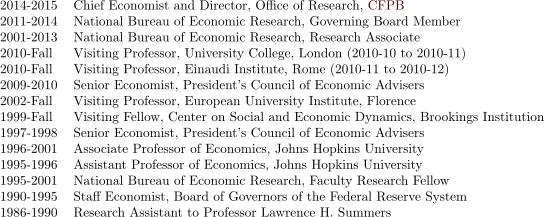
| 2001-present | Professor of Economics, Johns Hopkins University |
| 2001-2011 | National Bureau of Economic Research, Research Associate |
| 2011-2016 | National Bureau of Economic Research, Governing Board Member |
| 2000-present | Member, Conference on Research in Income and Wealth |
| 2006-present | Member, Center for Financial Studies, Goethe University, Frankfurt |
| 2010-Fall | Visiting Professor, Einaudi Institute for Economics and Finance, Rome (2010-12 to 2011-01) |
| 2010-Fall | Visiting Professor, University College, London (2010-10 to 2010-11) |
| 2009-2010 | Senior Economist, President’s Council of Economic Advisers |
| 2002-Fall | Visiting Professor, European University Institute, Florence |
| 1999-Fall | Visiting Fellow, Center on Social and Economic Dynamics, Brookings Institution |
| 1997-1998 | Senior Economist, President’s Council of Economic Advisers |
| 1996-2001 | Associate Professor of Economics, Johns Hopkins University |
| 1995-1996 | Assistant Professor of Economics, Johns Hopkins University |
| 1995-2001 | National Bureau of Economic Research, Faculty Research Fellow |
| 1990-1995 | Staff Economist, Board of Governors of the Federal Reserve System |
| 1989-1990 | Teaching Assistant, Department of Economics, MIT |
| 1986-1990 | Research Assistant to Professor Lawrence H. Summers |
1998 Paul A. Samuelson Certificate of Excellence for Research on Lifetime Financial Security
Recipient, Alfred P. Sloan Research Fellowship, 1997
Marquis Who’s Who, 2004-
Who’s Who in Economics, 2004-
Referee: American Economic Review, Quarterly Journal of Economics, Econometrica, Journal of Political Economy, Journal of Economic Literature, Journal of Monetary Economics, Review of Economics and Statistics, Review of Economic Studies, Journal of Business and Economic Statistics, Journal of Macroeconomics, Journal of Development Economics, Journal of Public Finance, Economic Development and Cultural Change, and others.
Panelist for Brookings Papers on Economic Activity, most BPEA meetings since 2006 (except 2009-10 when serving at Council of Economic Advisers)
Grant proposal reviews: National Science Foundation, UK Economic and Social Research Council (equivalent of NSF), Israeli Science Foundation, Sloan Foundation.
| Graduate Macroeconomic Theory (180.604) |
| Advanced Topics in Macroeconomics (180.606) |
| Undergraduate Public Finance (180.365) |
| Mathematical Methods for Economics, Part II (180.316b) |
| Graduate Macroeconomics Seminar (180.696) |
| Graduate Lecture Notes Online |
Member, Undergraduate Ethics Board (1998-2001)
Member, Department of Economics Computer Committee (1996-)
JHU Economics PhD Placement Director, 2002-2011
Dissertation Committees
Chair: Elif Arbatli, Burcu Duygan, Wendy Dunn, Michael Fratantoni, Johanna Francis, Christopher Geiregat, Joseph Gruber, Farhan Hameed, Jacques Miniane, Kevin Moore, Misuzu Otsuka, Matt Raskin, Jiri Slacalek, Martin Sommer, Delia Velculescu, Huiyan Lawrence Zhang, Xia Zhou, Kareem Ismail, Kiichi Tokuoka, Weifeng Wu
Second Advisor: Eugenio Cerutti, Selim Elekdag, Danny Barth
Peripheral Advisor: Kenji Abe, Witold Czubala, Gergana Danilova-Trainor, Arash Sotoodehnia, Manu De Veirman, Jacques Miniane
“International Evidence on Sticky Consumption Growth.” Christopher D. Carroll, Martin Sommer, and Jiri Slacalek. Review of Economics and Statistics 93(4):1135–1145 06 2011a. http://econ.jhu.edu/people/ccarroll/papers/cssIntlStickyC/
“How Large Are Housing and Financial Wealth Effects? A New Approach.” Christopher D. Carroll, Misuzu Otsuka, and Jiri Slacalek. Journal of Money, Credit and Banking 43(1):55–79 2011b. http://econ.jhu.edu/people/ccarroll/papers/cosWealthEffects/
“Precautionary Saving and the Marginal Propensity to Consume Out of Permanent Income.” Christopher D. Carroll. Journal of Monetary Economics 56(6):780–790 September 2009. http://econ.jhu.edu/people/ccarroll/papers/MPCPerm
“Recent Stock Declines: Panic or the Purge of ‘Irrational Exuberance’?.” Christopher D. Carroll. The Economists’ Voice 5 2008. http://www.bepress.com/ev/vol5/iss7/art6
“Precautionary Saving and Precautionary Wealth.” Christopher D. Carroll and Miles S. Kimball. Palgrave Dictionary of Economics and Finance, 2nd Ed. 2007. http://econ.jhu.edu/people/ccarroll/PalgravePrecautionary.pdf
“The Method of Endogenous Gridpoints for Solving Dynamic Stochastic Optimization Problems.” Christopher D. Carroll. Economics Letters pages 312–320 September 2006a. http://econ.jhu.edu/people/ccarroll/EndogenousGridpoints.pdf
“The Epidemiology of Macroeconomic Expectations.” Christopher D. Carroll. In Larry Blume and Steven Durlauf, editors, The Economy as an Evolving Complex System, III. Oxford University Press 2006b. http://econ.jhu.edu/people/ccarroll/epidemiologySFI.pdf
“Unemployment Risk and Precautionary Wealth: Evidence from Households’ Balance Sheets.” Christopher D. Carroll, Karen E. Dynan, and Spencer S. Krane. Review of Economics and Statistics 85(3) August 2003. http://econ.jhu.edu/people/ccarroll/krynoll.pdf
“Macroeconomic Expectations of Households and Professional Forecasters.” Christopher D. Carroll. Quarterly Journal of Economics 118(1):269–298 2003. http://econ.jhu.edu/people/ccarroll/epidemiologyQJE.pdf
“Portfolios of the Rich.” Christopher D. Carroll. In Household Portfolios: Theory and Evidence. MIT Press Cambridge, MA 2002. http://econ.jhu.edu/people/ccarroll/richportfolios.pdf
“A Theory of the Consumption Function, With and Without Liquidity Constraints.”
Christopher D. Carroll. Journal of Economic Perspectives 15(3):23–46 Summer 2001a.
http://econ.jhu.edu/people/ccarroll/ATheoryv3JEP.pdf,
Related: http://econ.jhu.edu/people/ccarroll/ATheoryv3NBER.pdf (more rigorous)
http://econ.jhu.edu/people/ccarroll/ATheoryMath.zip (software archive)
“Death to the Log-Linearized Consumption Euler Equation! (And Very Poor Health to the Second-Order Approximation).” Christopher D. Carroll. Advances in Macroeconomics 1(1):Article 6 2001b
“Individual Learning About Consumption.” Todd M. Allen and Christopher D.D. Carroll. Macroeconomic Dynamics 5(4) 2001. http://econ.jhu.edu/people/ccarroll/IndivLearningAboutC.pdf
“‘Risky Habits’ and the Marginal Propsensity to Consume Out of Permanent Income.” Christopher D. Carroll. International Economic Journal 14 (4):1–41 2000a. http://econ.jhu.edu/people/ccarroll/riskyhabits.pdf
“Solving Consumption Models with Multiplicative Habits.” Christopher D. Carroll. Economics Letters 68(1):67–77 2000b. http://econ.jhu.edu/people/ccarroll/HabitsEconLett.pdf
“Saving and Growth with Habit Formation.” Christopher D. Carroll, Jody R. Overland, and David N. Weil. American Economic Review 90(3): 341–355 June 2000. http://econ.jhu.edu/people/ccarroll/AERHabits.pdf
“Requiem for the Representative Consumer? Aggregate Implications of Microeconomic Consumption Behavior.” Christopher D. Carroll. American Economic Review, Papers and Proceedings 90(2): 110–115 May 2000c. http://econ.jhu.edu/people/ccarroll/RequiemFull.pdf
“Why Do the Rich Save So Much?.” Christopher D. Carroll. In Joel B. Slemrod, editor, Does Atlas Shrug? The Economic Consequences of Taxing the Rich. Harvard University Press 2000d. http://econ.jhu.edu/people/ccarroll/Why.pdf
“Does Cultural Origin Affect Saving Behavior? Evidence from Immigrants.” Christopher D. Carroll, Changyong Rhee, and Byungkun Rhee. Economic Development and Cultural Change 48(1):33–50 October 1999. http://econ.jhu.edu/people/ccarroll/censave.pdf
“How Important Is Precautionary Saving?.” Christopher D. Carroll and Andrew A. Samwick. Review of Economics and Statistics 80(3):410–419 August 1998. http://econ.jhu.edu/people/ccarroll/howbig.pdf
“Comparison Utility in a Growth Model.” Christopher D. Carroll, Jody R. Overland, and David N. Weil. Journal of Economic Growth 2(4):339–367 December 1997. http://econ.jhu.edu/people/ccarroll/compare.pdf
“The Nature of Precautionary Wealth.” Christopher D. Carroll and Andrew A. Samwick. Journal of Monetary Economics 40(1):41–71 1997. http://econ.jhu.edu/people/ccarroll/nature.pdf
“Unemployment Expectations, Jumping (S,s) Triggers, and Household Balance Sheets.”
Christopher D. Carroll and Wendy E. Dunn. In Benjamin S. Bernanke and Julio J. Rotemberg,
editors, NBER Macroeconomics Annual, 1997 pages 165–229. MIT Press Cambridge, MA 1997.
http://econ.jhu.edu/people/ccarroll/macroann.pdf, Source codes at
http://econ.jhu.edu/people/ccarroll/papers/CarrollDunn1.zip,
http://econ.jhu.edu/people/ccarroll/papers/CarrollDunn2.zip,
http://econ.jhu.edu/people/ccarroll/papers/CarrollDunn3.zip
“Buffer Stock Saving and the Life Cycle/Permanent Income Hypothesis.” Christopher D. Carroll. Quarterly Journal of Economics CXII(1):1–56 1997. http://econ.jhu.edu/people/ccarroll/BSLCPIH.zip
“On the Concavity of the Consumption Function.” Christopher D. Carroll and Miles S. Kimball. Econometrica 64(4):981–992 1996. http://econ.jhu.edu/people/ccarroll/concavity.pdf
“Does Consumer Sentiment Forecast Household Spending? If So, Why?.” Christopher D. Carroll, Jeffrey C. Fuhrer, and David W. Wilcox. American Economic Review 84(5):1397–1408 1994a. http://econ.jhu.edu/people/ccarroll/SentAERCarrollFuhrerWilcox.pdf
“Saving and Growth: A Reinterpretation.” Christopher D. Carroll and David N. Weil. Carnegie-Rochester Conference Series on Public Policy 40:133–192 June 1994. http://econ.jhu.edu/people/ccarroll/CarrollWeilSavingAndGrowth.pdf
“Are There Cultural Effects on Saving? Some Cross-Sectional Evidence.” Christopher D. Carroll, Changyong Rhee, and Byungkun Rhee. The Quarterly Journal of Economics CIX(3):685–700 August 1994b. http://econ.jhu.edu/people/ccarroll/crr-culture-qje.pdf
“How Does Future Income Affect Current Consumption?.” Christopher D. Carroll. The Quarterly Journal of Economics CIX(1):111–148 1994. http://econ.jhu.edu/people/ccarroll/howdoesfuture.pdf
“The Decline in U.S. Saving.” Christopher D. Carroll. Forum for Applied Research and Public Policy 8(4) 1993
“The Buffer-Stock Theory of Saving: Some Macroeconomic Evidence.” Christopher D. Carroll. Brookings Papers on Economic Activity 1992(2):61–156 1992. http://econ.jhu.edu/people/ccarroll/BufferStockBPEA.pdf
“Why is U.S. National Saving So Low?.” Lawrence H. Summers and Christopher D. Carroll. Brookings Papers on Economic Activity 1987(2):607–636 1987. http://econ.jhu.edu/people/ccarroll/NatSavSoLow.pdf
“Why Have Private Saving Rates in the US and Canada Diverged?.” Christopher D. Carroll and Lawrence H. Summers. Journal of Monetary Economics 20(2):249–279 1987. http://econ.jhu.edu/people/ccarroll/papers/CarrollSummersJME.pdf
“Consumption Growth Parallels Income Growth: Some New Evidence.” Christopher D. Carroll and Lawrence H. Summers. In B. Douglas Bernheim and John B. Shoven, editors, National Saving and Economic Performance. Chicago University Press Chicago 1991. http://econ.jhu.edu/people/ccarroll/papers/CParallelsY.pdf
“A Tractable Model of Buffer Stock Saving.” Christopher D. Carroll and Patrick Toche. NBER Working Paper Number 15265 August 2009. http://econ.jhu.edu/people/ccarroll/papers/ctDiscrete
“A Tractable Model of Precautionary Reserves, Net Foreign Assets, or Sovereign Wealth Funds.” Christopher D. Carroll and Olivier Jeanne. NBER Working Paper Number 15228 August 2009. http://econ.jhu.edu/people/ccarroll/papers/cjSOE
“Liquidity Constraints and Precautionary Saving.” Christopher D. Carroll and Miles S. Kimball. Manuscript, Johns Hopkins University 2005. http://econ.jhu.edu/people/ccarroll/papers/liquidRevised.pdf
“Theoretical Foundations of Buffer Stock Saving.” Christopher D. Carroll. Manuscript, Department of Economics, Johns Hopkins University 2011. http://econ.jhu.edu/people/ccarroll/papers/BufferStockTheory
“Housing Wealth and Consumption Expenditure.” Christopher D. Carroll. Paper Prepared for Academic Consultants Meeting of Federal Reserve Board, January 2004 2004. At http://econ.jhu.edu/people/ccarroll/papers/FedHouseWealthv2.pdf
“Discussion of ‘The Rise in U.S. Household Indebtedness: Causes and Consequences’.” Christopher D. Carroll. In Christopher Kent, editor, Financial Stability and the Economic System (Proceedings of a Conference at the Reserve Bank of Australia, August 22, 2007) 2007. http://www.rba.gov.au/PublicationsAndResearch/Conferences/2007/Dynan_Kohn_disc.pdf
“Discussion of ‘Macroeconomic Derivatives: An Initial Analysis of Market-Based Macro Forecasts, Uncertainty, and Risk’ by Gurkaynak and Wolfers.” Christopher D. Carroll. In Jeffrey B. Frankel, editor, NBER International Seminar on Macroeconomics. MIT Press 2005. http://econ.jhu.edu/people/ccarroll/discuss/ISOM/gw/2005-06.zip
The Economics of Saving and Growth: Theory, Evidence, and Implications for Policy. Klaus Schmidt-Hebbel and Luis Servén, editors. Cambridge University Press for the World Bank 2000. Book Review, Journal of Economic Literature
“The Adequacy of Retirement Saving.” Eric Engen, William Gale, and Cori Uccello. Brookings Papers on Economic Activity 1999(2) 1999. Published Discussion
OECD Global Capital Shortages: Real Threat or Pure Fiction? Book Review Journal of Economic Literature (1997)
James M. Poterba International Comparisons of Household Saving . Book Review Journal of Economic Literature (1996) 34(4)
James H. Gapinsky The Economics of Saving . Book Review Journal of Economic Literature (1994) 32(4)
“Sticky Expectations and Consumption Dynamics.” Christopher D. Carroll and Jiri Slacalek. Manuscript, Johns Hopkins University 2007
“Entrepreneurial Investment, Consumption Smoothing, and Dividends.” With Louis J. Maccini
“Sticky Consumption Growth and Housing Wealth Effects: Evidence from Australia.” Christopher D. Carroll, Crystal Ossolinski, and Jiri Slacalek. Work In Progress ongoing
“Social Learning and Buffer Stock Saving.” Christopher Carroll. Ongoing research project 2008